
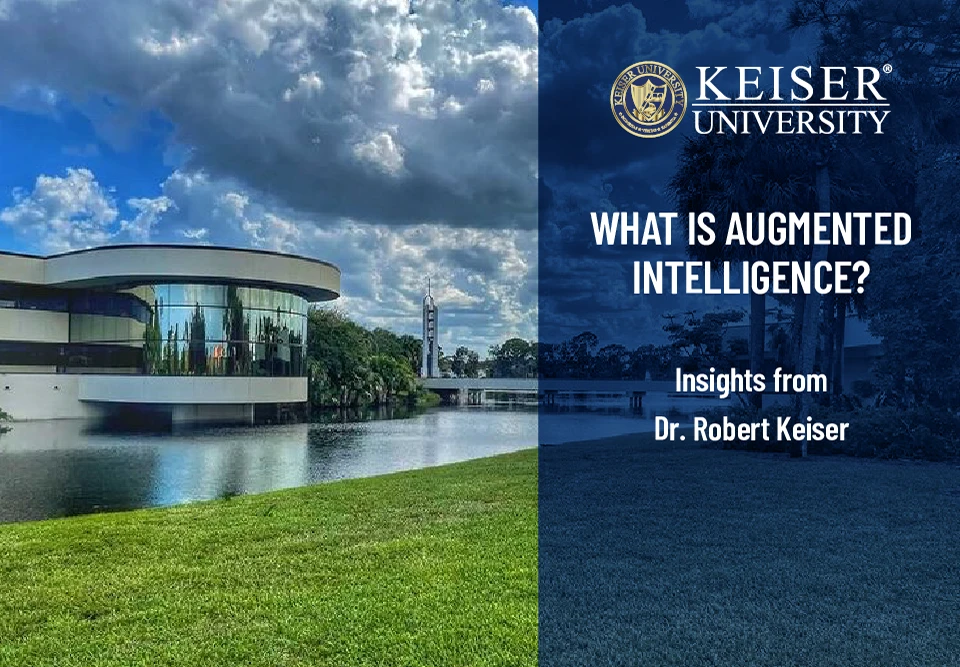
Artificial intelligence is changing how people learn and work, but Keiser University’s approach begins with a human question: How can technology strengthen people’s capabilities without displacing their judgment? Keiser University’s Center for Augmented Intelligence (CAI) provides an institutional framework for answering that question through education, governance, and workforce preparation.
Keiser’s Center for Augmented Intelligence: What Is Augmented Intelligence?
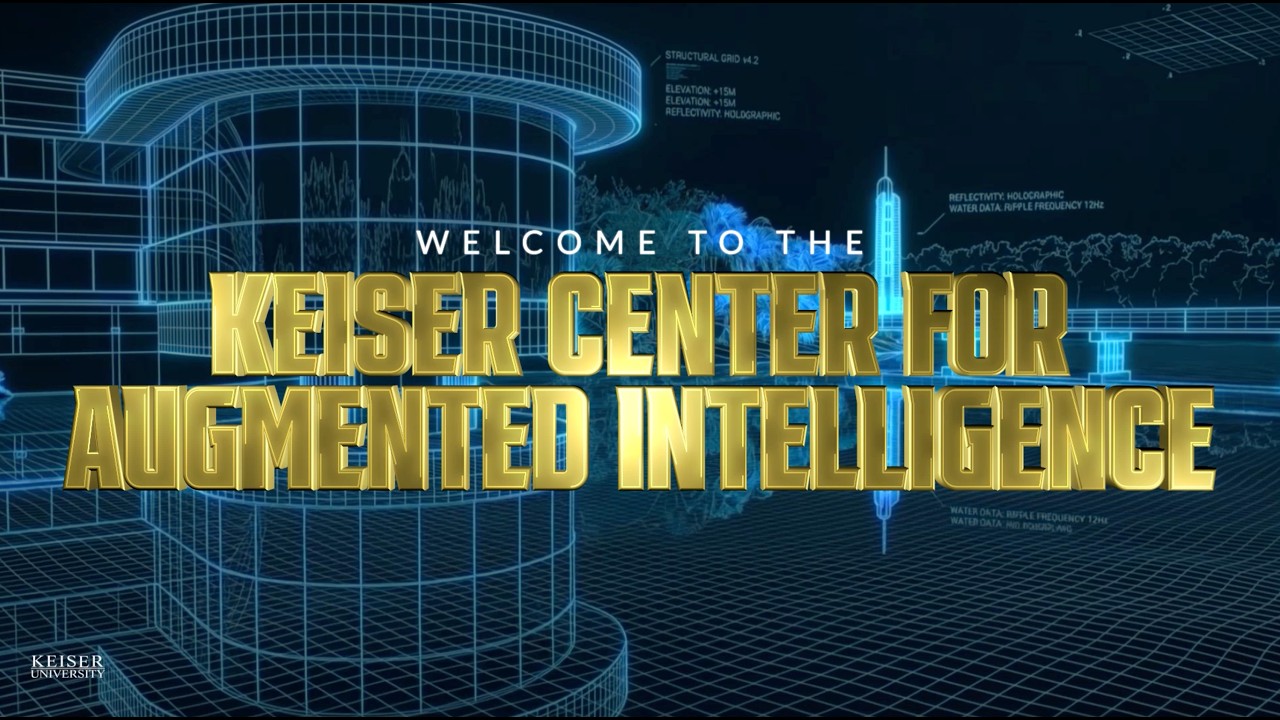
Keiser University created the Center for Augmented Intelligence to coordinate how the institution evaluates and integrates AI. As the university explains in its article Augmented, Not Replaced, the CAI makes human expertise the focus of technological change. Its work connects policy with practical adoption so that AI can support learning and professional practice without displacing human oversight.
The university’s introduction to the Center for Augmented Intelligence offers another overview of that mission. Together, these resources present the CAI as more than a collection of tools. It is a university-wide strategy for preparing students and employees to work thoughtfully alongside AI.
Augmented Intelligence, Not Artificial Intelligence: Why the Distinction Matters
For readers asking, “What is augmented intelligence?” the key distinction is who remains responsible. Artificial intelligence can generate analysis or recommendations, while augmented intelligence emphasizes the person who evaluates that output and decides how it should be used.
A related question asks, “How is augmented intelligence different from AI?” The answer concerns the purpose, not just terminology. AI describes a group of technologies. Augmented intelligence describes a human-centered approach to using them, with professional knowledge and ethical judgment guiding the final decision.
The Vision Behind the Center: Human Intelligence Strengthened by Technology
Dr. Robert M. Keiser, Ph.D., summarizes the vision directly: “The future is not about humans competing with AI. It is about humans working with AI.” This approach treats technology as a source of additional capacity while preserving the insight that people bring to complex situations.

Who Founded the CAI and What They Brought to It
The CAI was developed under the leadership of Dr. Keiser, chair of the center and vice chancellor of Keiser University Graduate School. His background in higher education leadership informs a model that connects institutional policy with career preparation. Rather than treating AI as an isolated technical subject, the center considers how it affects academic programs and the people responsible for delivering them.
How Keiser Thinks About AI Integration: What Drives the CAI’s Work
Keiser’s framework addresses AI adoption through governance, professional development, integration, and scaling. These connected areas give the university a way to respond to new tools without allowing short-term enthusiasm to replace careful evaluation. The CAI initiatives translate that framework into institutional priorities.
Governance: Building the Ethical and Policy Foundation for AI at Keiser
Governance establishes the conditions under which AI can be used responsibly. Keiser’s framework includes institutional review and policies for faculty and staff, creating a shared foundation for decisions about data, oversight and professional judgment. This structure supports responsible AI development because expectations are addressed before a tool becomes embedded in routine work.
Professional Development: Reskilling Faculty and Staff to Lead With AI
Technology cannot strengthen education if faculty and staff lack the time or guidance to evaluate it. Structured professional development helps employees build practical fluency while considering how AI fits their responsibilities. Research on faculty enablement can also inform how institutions support educators through this transition.
Workforce Relevance as the Standard
The CAI approaches AI literacy through the demands of each profession. A nurse and a financial analyst may use similar technology, but they apply different standards when interpreting its output. Keiser’s curriculum strategy therefore connects technical fluency with disciplinary knowledge rather than separating AI into a single elective.
That perspective can extend across emerging fields. Keiser’s articles on blockchain technology and AI in information security practices illustrate how technological change takes on a different meaning in each professional context.
Principles Over Prescriptions: Responding to AI Evolution with Agility
Specific tools may change before a curriculum can be redesigned around them. Durable principles give educators a steadier foundation by emphasizing verification, transparency, and human accountability. Programs can then respond to machine learning innovations without tying instruction to a platform that may soon be outdated.
AI-Informed Innovation and Competencies in a Professional Setting
Professional AI competency involves more than writing prompts. Students need to know when a tool is appropriate and how to test what it produces. They must also recognize situations in which professional standards require a different approach. These habits turn technical exposure into informed judgment.
What Keiser Is Building Now: AI Initiatives at the CAI
The CAI’s current work applies its principles across academic and institutional settings. Each initiative addresses a different part of AI adoption while supporting the same goal: technology should expand human capability and remain accountable to the people it serves.
AI-Enhanced Academic Programs
Keiser is working to integrate AI literacy within academic disciplines so that students encounter the technology in a relevant context. This model of AI-augmented education connects classroom learning with the standards graduates will face in their fields. Keiser’s discussion of the impact of AI on education offers additional context on how these tools are influencing learning environments.
Workforce-Aligned Education: Building Employer-Verified AI Frameworks
Employer input can help the university identify the AI capabilities that matter in a particular role. Those expectations can then inform competencies and assessments without allowing one company or tool to define the curriculum. In finance, for example, Keiser has examined how fintech and artificial intelligence are reshaping professional practice.
AI-Powered Student Support
Student support offers a practical setting for human-centered AI. A digital resource can answer routine questions when an employee is unavailable, while advisors remain responsible for issues that require context or discretion. The value comes from widening access to information rather than presenting automation as a substitute for relationships.
Structured Professional Development for Faculty Enablement
Faculty development gives educators room to test AI before using it in a course. Training can address the technology itself while helping instructors evaluate assignments and academic standards considering new capabilities. Faculty members can then make informed choices instead of following a universal prescription.
Institutional Innovation Using AI
AI can also support university operations by organizing information or revealing patterns that deserve closer review. Human interpretation remains essential because a pattern does not explain its own cause. Used carefully, these insights can help Keiser identify where a process needs attention and determine an appropriate response.
Community and Employer Partnerships: AI Pathways and Pipelines
Partnerships allow Keiser University to compare its academic priorities with changing workplace expectations. They can also support new pathways for professionals whose roles are being reshaped by AI. Continued dialogue helps the CAI distinguish durable competencies from temporary trends.
What the CAI Means for Graduate Students at Keiser University
For graduate students, the CAI connects advanced study with the realities of a changing workplace. Its influence is not limited to exposure to new software. The larger goal is to help students apply disciplinary expertise when technology changes how professionals approach a problem.
How the CAI Changes the Relationship Between Graduate Study and Career Readiness
Career readiness in an AI-shaped workplace requires graduates to evaluate automated output within the standards of their field. A business student may scrutinize a model’s assumptions, while an education student considers whether a tool serves a learning objective. Graduate study provides the subject knowledge that makes those judgments possible.
Thinking, Leading and Creating Alongside AI: The Graduate Outcomes the CAI Is Building Toward
The CAI aims to prepare graduates to approach professional challenges with sound judgment and ethical awareness. Creative capability remains equally important. AI can extend those strengths, but it does not replace the person who defines the goal or accepts responsibility for the result.
Keiser Guru: What an AI Tool Built for Students Actually Looks Like
One clear example of the CAI’s philosophy is Keiser Guru, an AI-powered guide developed for admitted graduate students. The tool shows how augmented intelligence can make university information easier to access while directing students to official resources and offices when appropriate.
What Keiser Guru Does and Why It Was Built
Keiser Guru provides answers about graduate programs and university policies. It also offers interactive guides and links to student services. Because its information comes from university resources, the app can help students begin navigating a question before contacting the office responsible for official guidance.
What Keiser Guru Represents Beyond Student Services
The tool illustrates a division of work central to augmented intelligence. AI handles a routine information request, giving university employees more capacity for situations that depend on personal attention. Students gain faster access to resources without losing the option of human support.
Community Engagement and the Keiser Plus AI Podcast
The CAI also creates opportunities for discussion beyond individual classrooms. Employers and educators can contribute perspectives that help the university understand how AI is changing professional expectations. Community engagement keeps that conversation connected to the people experiencing the change.
The Keiser Plus AI Podcast: Real Conversations About AI in Teaching, Research, and Operations
The Keiser Plus AI podcast introduces the center and opens a broader conversation about AI in higher education. Future discussions can connect AI research with practical questions arising in teaching and university operations.
The podcast may also make emerging concepts more accessible. One example is augmented reality business intelligence, which uses immersive interfaces to help people explore business data. Defining such terms gives listeners a clearer basis for evaluating where a technology may be useful.
Scaling: Taking the CAI’s Model Across Campuses and Into the Workforce
Scaling the CAI means extending a human-centered model across programs and professional settings. That work may include artificial intelligence and augmented reality in education, but the technologies are not interchangeable. AI can analyze or generate information, while augmented reality places digital material within an interactive environment. A shared framework helps educators assess each tool according to its purpose.
Why Community Engagement Is a Core CAI Strategy, Not an Add-On
No institution can anticipate the effects of AI in isolation. Employers can describe how roles are changing, while community organizations can identify barriers that a university might otherwise miss. Their participation gives the CAI a stronger basis for building pathways that reflect real needs.
Advance Your Career with Keiser University Graduate School
Take the next step toward your professional goals with a graduate degree from Keiser University. The Graduate School offers career-focused master’s, specialist and doctoral programs designed to fit the lives of working professionals. With flexible online learning options and industry-experienced faculty, students receive personalized support from a university with nearly 50 years of academic excellence. They can also build the knowledge and leadership skills needed to make an impact in their career field.
The Graduate Student Who Graduates from Keiser in the Age of the CAI Is Different
The Center for Augmented Intelligence reflects Keiser University’s commitment to preparing graduates for a world shaped by AI. Students are expected to participate in that change as informed professionals who can pair technological fluency with sound judgment.
Whether you are pursuing a graduate degree in business, education, healthcare, criminal justice or psychology, the CAI’s work can help connect your program with emerging professional demands. Explore the Center for Augmented Intelligence to learn more about its approach.
Visit our graduate school page or contact a graduate admissions counselor to learn more about our degree programs.


 After experiencing profound personal loss, Sydney Nau found her purpose in nursing. Today, she leads with compassion while advancing her education and transforming lives through patient-centered care.


