


Operations management shapes decisions across nearly every industry, and it’s one of the concentrations you can pursue within Keiser’s Business Administration program. If you’re considering a business concentration, this guide draws on insight from Gabriel Isaacs, University Department Chair, Business, at Keiser University and provides a clear picture of what operations management involves and how it differs from supply chain management.
What You Should Know Before You Start
Is operations management a growing career field?
Yes. Demand for general and operations managers is projected to grow 5 percent from 2025 to 2035, per the U.S. Bureau of Labor Statistics’ Job Outlook data [2], since any organization producing a product or delivering a service needs someone coordinating the work.
What skills or qualities help you succeed in operations management?
You’ll likely do well if you’re comfortable making decisions when you don’t have all the information. Strong communication is just as important as analytical skills because your work depends on keeping departments connected and aligned, even when they don’t typically work closely together.
How long does it typically take to become qualified for an operations management role?
Most employers expect a bachelor’s degree in business or a related field, which typically takes about four years, plus relevant experience before you reach a management role. Certifications pursued after your degree tend to accelerate career advancement.
Table of Contents
- What Is Operations Management?
- Operations Management vs Supply Chain Management
- Common Misconceptions About Operations Management
- Why Is Operations Management Important for Business Success?
- The Core Objectives of Operations Management
- Key Functions and Tools Operations Managers Use
- How Keiser’s Business Administration Program Prepares You
- Career Paths and Certifications in Operations Management
- Why Keiser University
- Frequently Asked Questions
What Is Operations Management?
The U.S. Department of Labor’s O*NET database [3] describes general and operations managers as professionals who plan, direct, or coordinate an organization’s operations. At its core, operations management means making sure all the moving parts of a business work together, so the result is a product or service you rely on as a customer. Gabriel Isaacs describes integration as one of the most important aspects of the role, since operations often connects teams such as sales, production, inventory, and procurement.
“The key function of operations management is integration. An organization has a sales department, a production department, materials and inventory management, procurement, and more. At its best, operations management integrates these functions to achieve the highest possible efficiency and productivity.”
Gabriel Isaacs, University Department Chair, Business, Keiser University
Gabriel Isaacs notes that this integration is part of why operations typically ranks among a company’s three most common executive roles, alongside the CEO and the CFO, who handles finance. Operations management isn’t limited to factories: a bank practices it too, since queue design and how tellers handle uneven transaction volume affect your experience as a customer.
Operations Management vs Supply Chain Management

The Association for Supply Chain Management [4] defines supply chain management as the design, planning, execution, control, and monitoring of supply chain activities aimed at creating net value and synchronizing supply with demand. In large organizations, it often functions as its own discipline, coordinating the flow of goods from sourcing through delivery alongside production and manufacturing.
At Keiser University, our Business Administration program combines Operations Management and Supply Chain Management into a single required course within the Management concentration. If you’re drawn specifically to the movement of goods across borders, compare that path against our separate Transportation and Logistics concentration, offered within the same degree.
Common Misconceptions About Operations Management
Two misconceptions come up most often: that operations management only applies to production and warehousing, when it actually covers any business that turns inputs into a product or service, banks and hospitals included, and that it’s the same as general management, when saying “I run the day shift” describes general management, since operations management is a more focused set of disciplines rather than day-to-day supervision alone.
At Keiser University, our Business Administration program addresses both directly within its Management concentration coursework. Gabriel Isaacs notes that coursework typically breaks the field into a few different areas, including:
- Production management
- Quality management
- Maintenance management
- Location management
- Human resource management
- Supply chain management
- Procurement
Why Is Operations Management Important for Business Success?

Gabriel Isaacs has seen firsthand what happens when operations break down. At one company he worked with, production constraints weren’t communicated clearly across teams, and quality suffered once goods reached the United States, forcing a fix across the supply chain, sales, and finance at once.
That’s why quality management is about more than checking a finished product: it’s about moving the right information between departments before a small problem becomes a much bigger one. A satisfied customer might tell three or four people about a good experience, Gabriel Isaacs notes, while a dissatisfied one will tell around fifteen.
“A process running at a true six sigma level produces roughly one error every two million attempts, a success rate of about 99.99966 percent.”
Gabriel Isaacs, University Department Chair, Business, Keiser University
According to the American Society for Quality [5], a true Six Sigma level allows only 3.4 defects per million opportunities, roughly one mistake per year for a business handling 1,000 customer interactions a day.
The Core Objectives of Operations Management
Operations management aims to minimize operating expenses while improving quality, two goals that don’t always pull in the same direction. At Keiser University, the business programs curriculum is built around:
- Controlling operational costs without compromising output
- Maintaining consistent quality and customer satisfaction
- Achieving optimal capacity utilization
- Managing labor and material resources efficiently
- Supporting company objectives through process optimization
Key Functions and Tools Operations Managers Use
Several functions repeat across nearly every operations management role, regardless of industry:
- Capacity planning
- Scheduling
- Inventory management
- Facility location and layout
- Process design
- Quality control and resource allocation
Together, these functions keep a business’s day-to-day promises to customers: on schedule, in stock, and at the expected level of quality. That combination is a good fit if you enjoy solving practical problems that affect different areas of a business.
Technology has changed how you’d execute these functions without changing the underlying goals:
- Automation reduces manual effort on repetitive tasks
- IoT (Internet of Things) sensors provide real-time visibility into connected equipment
- Digital twins let you simulate changes before making them on a live process
If you want to build data-driven skills alongside operations coursework, explore our Business Analytics Bachelor’s program as a complementary path.
How Keiser’s Business Administration Program Prepares You
At Keiser University, our Business Administration, BA program builds operations management coursework into its Management concentration, including the required course covering operations and supply chain management.
Every Business Administration student, not only those in the Management concentration, also completes Project Management as a required upper-division course. Students who finish the Management concentration and want to advance their career can pursue an MBA in Management.
Career Paths and Certifications in Operations Management
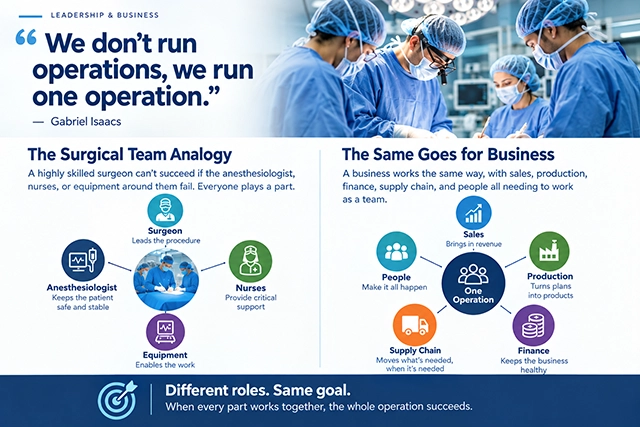
Gabriel Isaacs explains operations management simply: “We don’t run operations, we run one operation.” He compares it to a surgical team, since a highly skilled surgeon can’t succeed if the anesthesiologist, nurses, or equipment around them fail. A business operation works the same way: sales, production, finance, and supply chain need to work as a team.
That same interconnected thinking is one reason professionals may pursue a graduate business certificate that builds on a Business Administration degree. Whether the focus is operations, manufacturing, finance, or another area, specialized certifications can help professionals build deeper expertise while better understanding how their role contributes to the organization. Common certificate options include:
- Lean Six Sigma
- Project Management Professional (PMP)
- Certified in Production and Inventory Management (CPIM)
- Certified Supply Chain Professional (CSCP)
- ISO 9000 Lead Auditor status, the same credential Gabriel Isaacs holds
Operations management skills apply to roles such as general manager, operations manager, operations director, and plant superintendent, per O*NET [3]. With significant experience, some professionals move into senior leadership roles, including chief operating officer.
Why Keiser University
At Keiser University, we know that understanding operations management in theory is only one aspect of preparing for this career. Our Business Administration program helps you connect what you learn in class with real-world business operations. Gabriel Isaacs brings his vast experience in Operations Management into the classroom.
If you are balancing study with work, family, or military commitments, we offer flexible learning options, including online, on-campus, and one-class-at-a-time formats.
As Keiser University prepares to celebrate 50 years of empowering students through career-focused education, it continues a legacy of academic excellence and student success while helping shape the future of higher education. Since opening its doors in 1977, the university has remained committed to preparing graduates with the knowledge, skills, and hands-on experience needed to succeed in today’s workforce.
As a Keiser University student, you’ll benefit from:
- An institutionally SACSCOC-accredited university where degrees are valued by employers and institutions nationwide.
- Over 100 programs aligned with today’s workforce, providing the real-world experience employers look for.
- Flexible learning options, including on-campus, online, hybrid, and one-class-at-a-time formats.
- Personalized academic and career support, with dedicated faculty and career services.
- Financial aid, scholarships, and tuition guidance to help make education more accessible.
- Proud membership in the Hispanic Association of Colleges and Universities (HACU).
- Almost 50 years of educational excellence with a proven focus on student success and outcomes.
Review Keiser’s admissions requirements and tuition, or explore our program catalog.
We can help you explore the business program options that can best fit your career goals.
Request Information | Apply Now
Frequently Asked Questions
What is operations and supply chain management?
Operations and supply chain management is the process by which an organization transforms inputs into outputs while managing the flow of goods between suppliers, manufacturers, and customers. Supply chain management focuses on the external flow of goods, while operations management covers the broader internal process of turning inputs into a finished product or service.
What are the objectives of operations management?
The main objectives of operations management are controlling cost, maintaining quality, meeting timelines, and using capacity efficiently. Those objectives should align with a company’s broader goals.
How much do operations managers make?
According to the BLS report published August 27, 2026 [1], the median annual wage for general and operations managers was $105,770 in May 2025, with employment for top executive roles projected to grow 5 percent from 2025 to 2035. Pay varies by industry and experience, so treat this as a starting point.
Is operations management the same as project management?
No. Operations management covers ongoing business processes with no defined end date. Project management focuses on time-bound efforts with a clear deliverable, such as launching a new product line. The two disciplines overlap enough that professionals in either field benefit from understanding both.
Is operations management the same as general management?
No. General management typically covers broad, day-to-day supervision of a team or shift. Operations management is a more focused discipline built around specific functions, like capacity planning, quality management, and supply chain coordination, that a formal course of study breaks down individually.
Contributing Author

Gabriel Isaacs serves as University Department Chair, Business, at Keiser University, where he also directs the Business Administration program. He is Chief Operating Officer at Resource Conservation Technologies/Vizco US and holds PMP, Lean Six Sigma, and ISO 9000 Lead Auditor certifications. The insight throughout this guide draws on his experience leading operations in both academic and industry settings.
Sources
- U.S. Bureau of Labor Statistics, Occupational Outlook Handbook, “Top Executives.” Median Wage #Tab 5.
- U.S. Bureau of Labor Statistics, Occupational Outlook Handbook, “Top Executives.” Job Outlook #Tab 6.
- U.S. Department of Labor, O*NET OnLine, “General and Operations Managers.”
- Association for Supply Chain Management (ASCM), “Supply Chain Management” topic page.
- American Society for Quality (ASQ), “Six Sigma” quality resource page.


 After experiencing profound personal loss, Sydney Nau found her purpose in nursing. Today, she leads with compassion while advancing her education and transforming lives through patient-centered care.


