


In 1995, prosecutors in the O.J. Simpson murder trial walked into court with what appeared to be overwhelming physical evidence: blood at the crime scene, DNA linking the defendant to the victims, and a bloody glove recovered from his property. The jury returned a not guilty verdict.
One of the most decisive factors wasn’t the volume of evidence, it was what happened to that evidence along the way. A missing 1.5 mL of Simpson’s reference blood, a vial carried around for hours before being logged, fingerprint evidence never properly entered into the chain of custody, and storage facilities accessed by unauthorized personnel, these failures gave the defense everything it needed. The prosecution’s case unraveled not in the science, but in the documentation.
That’s the power of the chain of custody. And it’s the reason every forensic investigator must understand it completely before stepping foot on a crime scene.
What Is Chain of Custody?
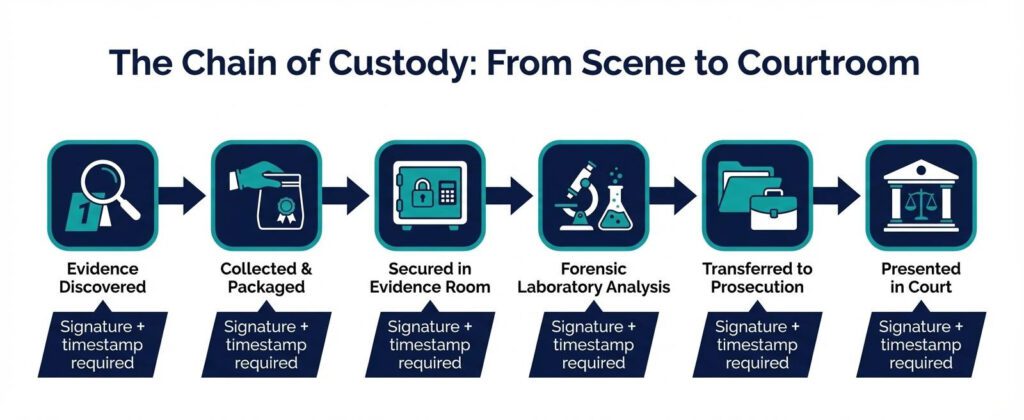
Chain of custody is the chronological documentation that records the sequence of custody, control, transfer, analysis, and disposition of evidence. According to the National Institute of Justice, it is a recorded means of verifying where evidence has traveled and who handled it before trial.
The purpose isn’t bureaucratic, it’s legal protection. Custody documentation prevents substitution, tampering, contamination, misidentification, and falsification of evidence. Without proof of an intact chain, a court may exclude evidence entirely or instruct the jury to give it little weight. That single outcome can dismantle a prosecution that took years to build.
The chain of custody form requires a signature, date, and time every time the charge of evidence changes hands. According to StatPearls, evidence remains in “legal custody” only when stored in a manner that prevents unauthorized access, typically locked lockers or secured facilities with audited entry logs. Each item must be uniquely identifiable through its case number and item number to prevent mix-ups that could be exploited in court.
Alyce Clark, Department Chair for Crime Scene Technology and Forensic Investigations at Keiser University, uses a classroom exercise to make this concrete. She asks students to write a paragraph describing exactly how to make a peanut butter and jelly sandwich, then reads it aloud and acts it out to the letter — placing the jar on the bread without a knife, because that is what they wrote. The exercise reveals how imprecise language creates gaps, and how those gaps translate directly to evidentiary failures.
“Another thing that I do is when we do the collecting of the evidence part — they come and hand it to me and I look at it and I’ll just throw it on the floor. So that kind of sticks in their head. They’ll remember that. And that’s something that I think sticks with them versus just giving you a grade.”
— Alyce Clark, Department Chair, Crime Scene Technology & Forensic Investigations, Keiser University
Chain of Custody and Crime Scene Investigation
The chain of custody is established the moment a crime scene investigator takes custody of evidence at the scene. From that point forward, every person who touches it, every lab it passes through, and every transfer to prosecutors, defense attorneys, or court personnel must be documented without interruption.
Crime scene investigators, including those trained through programs like Keiser’s Crime Scene Technology AS, are often the first professionals to establish this chain. Before any collection happens, they must thoroughly document the crime scene through photographs, detailed sketches, measurements, and written notes that include the date, time, and precise geographical coordinates of each piece of evidence. Digital and video cameras, and increasingly 3-D scanners, are now standard tools for this documentation phase.
First responders play a critical role in the earliest moments. They’re responsible for securing the scene, preventing unauthorized access, and preserving conditions until crime scene technicians arrive. Contamination introduced in those first hours, from weather conditions, bystander activity, or failure to establish a perimeter, can compromise evidence before a single item is ever collected. A formal crime scene report must document the scene’s condition at the time of arrival, establishing the baseline for everything that follows.
Every investigator must also use personal protective equipment throughout the process. Sterile gloves, clean tools, and careful movement through the scene are not optional steps, they are the first line of defense against cross contamination that could later be used to challenge the integrity of collected evidence.
Clark draws on 17 years at the Norfolk Police Department — including nearly a decade as a detective and four years as a sworn forensic investigator — when explaining why early scene decisions are irreversible. She points to attention to detail as the single quality that military service instilled most strongly in her own career.
“Attention to detail is the number one thing I noticed for myself being in the military. That can make or break a case. I always see, oh, you missed a belt loop — something so tiny like that can really make or break a case when you’re collecting evidence.”
— Alyce Clark, Department Chair, Crime Scene Technology & Forensic Investigations, Keiser University
She learned this the hard way early in her career. Responding to a burglary, she found and collected a stolen gun from the backyard — but never swabbed it for DNA. That missing step broke the case. Her conclusion: a checklist alone is never enough, because checklists are static and crime scenes are not.
Types of Evidence and What Crime Scene Investigators Look For

Crime scene investigation involves identifying, evaluating, collecting, and packaging many different types of evidence. Each type carries its own handling requirements, and understanding those distinctions is foundational to maintaining a defensible chain of custody.
The main categories found at crime scenes include:
- Trace evidence: Materials such as hairs, fibers, glass, soil, paint, and bullet fragments. Trace physical evidence is often invisible to the naked eye and requires alternate light sources or chemical enhancement techniques to visualize it before collection.
- Biological evidence: Blood, skin cells, saliva, semen stains, and other body fluids and bodily fluids that may contain DNA. This is among the most probative, and most fragile, evidence collected at any scene.
- Latent print evidence: Fingerprints and latent prints not visible without enhancement. These are developed using powders, chemical reagents, or alternate light sources, depending on the surface material.
- Impressions: Footwear patterns, tire tracks, and tool marks, which may require casting to preserve.
- Digital and electronic evidence: Phones, computers, tablets, and smart devices that may contain data relevant to the investigation.
- Weapons, clothing, controlled substances, questioned documents, and explosives.
The nature of the crime determines which types of evidence are most likely to be present and which collection methods are appropriate. A seasoned crime scene investigator recognizes evidence that others might overlook, including items not apparent to the naked eye.
Biological Evidence, Trace Evidence, and the Evidence Collection Process
The evidence collection process must be systematic and methodical. Fragile evidence, including latent prints, trace physical evidence, and perishable biological evidence, is prioritized and collected first, since it’s most at risk of loss from weather conditions, disturbance, or degradation.
Investigators must change sterile gloves and use clean tools between individual items to prevent cross contamination. The evidence collection process follows a strict sequence: document, then collect, package, label, and transport. Skipping or reversing any step creates the documentation gaps that defense attorneys look for.
Biological evidence requires special handling to prevent contamination and preserve DNA integrity. Blood, semen stains, saliva, and other body fluids must be allowed to air dry before packaging. Wet biological samples should never be placed in plastic bags, which trap moisture and accelerate bacterial breakdown, paper bags are the correct choice. Digital devices, by contrast, require Faraday bags that block electromagnetic signals and prevent remote wiping of data.
Trace evidence, hairs, fibers, and other minute materials, is collected using tape lifts, clean tweezers, or swabs, then placed in appropriate sealed containers. Alternate light sources are frequently used to identify trace physical evidence before collection begins, making biological stains, fibers, and other materials fluoresce against the scene background.
Each item of evidence must be properly labeled with the collector’s name, the date and time of collection, the case number, an item number, and a brief description. This identifying information forms the foundation of custody documentation that will accompany the evidence through its entire lifecycle, from the scene to the crime laboratory and, eventually, to court.
From Crime Scene to Crime Laboratory: Following the Chain
Once collected and properly labeled, evidence travels to the crime laboratory for forensic analysis. Each person who handles the evidence at any point is a link in the chain, from the officer who recovered it, to the technician who analyzed it, to the prosecutor who received the forensic report. Every one of them may be called to testify about the evidence’s condition and the procedures performed while it was in their custody.
The examination and forensic analysis conducted at the crime laboratory must be fully documented. Any change to the evidence, even a sample removed for DNA testing, must be logged on the chain of custody form. Evidence must remain in a secured evidence room with controlled access throughout its time at the lab, and any access must be entered into an audited log.
Technology is advancing the process. Portable analytical tools now allow for near-laboratory quality forensic analysis results at the scene of the crime, shortening the chain and reducing the risk of documentation gaps during transport. As these tools improve, more procedures performed on evidence will likely take place on-site, but the documentation requirements remain exactly the same regardless of where analysis occurs.
The chain concludes only when evidence is presented in court, returned to its owner, or lawfully destroyed. Each of those endpoints requires complete documentation with the same rigor applied at every prior stage.
How the Chain Breaks, and What Happens in a Criminal Case

A chain of custody can be broken at any point along its journey. Legal experts distinguish between two types of failures with very different consequences. A weak link occurs when documentation is circumstantial but each custodian can still be accounted for, this raises questions of credibility and weight, not necessarily admissibility. A missing link, where a transfer or custodian can’t be accounted for at all, results in the evidence being ruled inadmissible.
The most common causes of chain failures in criminal case prosecutions include:
- Failure to log evidence immediately upon collection, allowing speculation about where it was between collection and logging
- Incomplete custody documentation, unsigned forms, missing timestamps, or unexplained gaps between transfers
- Improper storage, biological evidence not refrigerated, samples left in conditions that cause degradation, or evidence stored in unsecured areas
- Cross contamination from failure to change gloves or use clean tools between individual items
- Evidence changing hands without documented transfers, or being accessed by personnel without authorization
- Tampering or alterations to evidence at any point in its handling, even minor ones
When evidence is ruled inadmissible, the prosecution may be left with little or nothing to present to a jury. If the excluded evidence is central to the case, a DNA sample, a weapon, a digital device, charges may be reduced or dismissed entirely. Compromised chain of custody procedures have contributed to thousands of overturned convictions after evidence was found to have been mishandled or falsified.
Defense attorneys are well aware of this. Standard defense strategy is to attack the chain link by link, searching for irregularities in the timeline, documentation gaps, labeling errors, or storage failures. A single broken seal on an evidence container, something as seemingly minor as a bag that wasn’t properly secured, may be enough to establish reasonable doubt in a jury’s mind.
Clark identifies complacency as the most persistent failure pattern she sees in the field — and now in the classroom. Rushing timestamps, batch-processing paperwork after the fact, adjusting times by a single minute: each shortcut creates the documentation gap a defense attorney needs.
“I’ve seen people in the field collect everything and then just figure out the times later. Or they collect one item, put the time on there, collect everything else after that, and just change it by one minute. You have as much time as you need on that scene, so take it. Whatever’s on that envelope is what the forensic lab is requesting to be there.”
— Alyce Clark, Department Chair, Crime Scene Technology & Forensic Investigations, Keiser University
On the O.J. Simpson case specifically, Clark frames it as a contamination failure that closed the door permanently — not just on that conviction, but on any future one.
“Contamination can ruin a case. If there’s contamination, you’re probably never going to get a conviction — even if that person was a suspect or somebody else. Because of the contamination in the O.J. Simpson case, there’s probably never going to be a conviction, ever. I’ve noticed that police officers are still not collecting certain evidence correctly — DNA in plastic instead of paper. The bacteria that forms in plastic will eat the DNA and kill it. You’re not going to get any hits back. And I think some of them are learning from TV.”
— Alyce Clark, Department Chair, Crime Scene Technology & Forensic Investigations, Keiser University
Chain of Custody and Digital Evidence
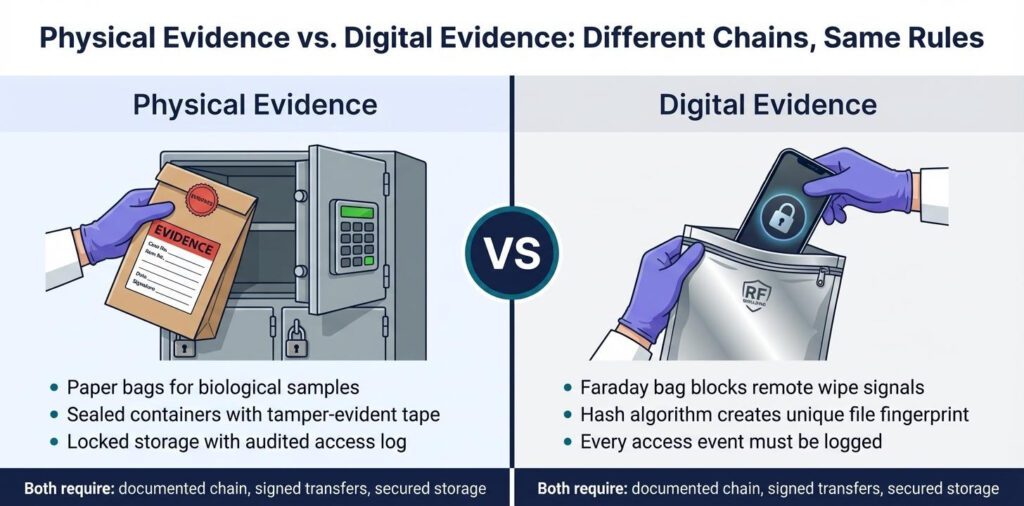
Digital evidence now plays a central role in criminal investigations. A survey of police chiefs, agency managers, examiners, investigators, and prosecutors found that 66% believe digital evidence has surpassed physical evidence in importance. With that shift comes an entirely new set of chain of custody challenges that every forensic investigator needs to understand.
Digital files can be altered or duplicated without leaving any obvious physical trace. Even a single undocumented access event, or a mismatched hash value, can give the defense grounds to argue that files were modified after collection. Maintaining a verifiable digital chain of custody means documenting every person who accessed the data, every tool used, and every action taken, even routine ones.
Investigators working in digital forensics and incident response must also act quickly. Data can be erased remotely if a phone or computer isn’t secured immediately at the scene. Faraday bags block electromagnetic signals to prevent this. Hash algorithms create unique digital fingerprints that verify files haven’t been altered since collection, a critical component of any digital chain of custody that will be scrutinized in court.
@keiseruflagship Here’s what happens as a Criminal Justice and Forensic Science student at @keiseruflagship #criminaljustice #forensicscience #collegetok #crimjusticemajor #keiseruniversity #keiseruflagship ♬ Sunroof – Nicky Youre & dazy
Preparing for a Career in Forensic Investigations at Keiser University
The O.J. Simpson case, the wrongful conviction of David Camm, and countless less-publicized cases share a common thread: the outcome turned not on whether the evidence existed, but on whether it was handled correctly from the moment it was collected. For anyone pursuing a career in forensic investigations, this is the lesson that matters above all others.
Clark has spent years teaching students that documentation is not the bureaucratic burden of forensic work — it is the work. Her own reputation in Norfolk was built on notes so detailed that defense attorneys advised clients to consider a plea rather than go to trial.
“Everything that you do gets sent to the prosecutor, and in turn they give that to discovery. If you get the reputation that your notes suck, defense attorneys are going to rip that apart. But if your notes are awesome — very detailed, very attentive — defense attorneys look at that. I got to the point where my notes were so detailed, the defense attorney told their client they should probably plea.”
— Alyce Clark, Department Chair, Crime Scene Technology & Forensic Investigations, Keiser University
At Keiser, Clark has restructured the Forensic Investigations curriculum around this principle, adding electives in victimology, forensic psychology, ethics, and crime in the media — all mapped to what investigators actually encounter in the field. Local CSI units visit as guest speakers, and students attend autopsies early in the program so they can determine quickly whether this career is the right fit for them.
Keiser University’s Bachelor of Science in Forensic Investigations (Investigations Concentration) is designed to prepare students with competencies in the collection, preservation, and analysis of physical evidence for presentation in legal proceedings. The program covers the scientific, procedural, and legal dimensions of evidence handling, including coursework in Field Investigative Procedures and Presentation of Evidence, Forensic Legal Concepts, Advanced Evidence Documentation, Criminalistics, and Advanced Legal Procedure and Evidence.
Students can also explore the Forensic Investigations (Science Concentration) BS or a Criminal Justice BA as complementary pathways within the criminal justice field.
Keiser offers small class sizes, flexible scheduling, and on-campus programs at Florida locations, Flagship, Fort Myers, Orlando, Pembroke Pines, Port St. Lucie, Tampa, and West Palm Beach. Whether you’re a recent high school graduate, a career changer, a working professional, or a military veteran looking to build on your service, Keiser is designed to support your path forward. Speak with an admissions counselor to learn more about the Forensic Investigations program and find the campus that works for you.
About Keiser University
Since 1977, Keiser University has been empowering students to achieve their career goals through career-focused education. As one of Florida’s largest private, non-profit universities, Keiser is accredited by SACSCOC, ensuring educational quality and effectiveness.
Keiser University’s reputation lands on its commitment to a “students first” philosophy designed to support working adults, transfer students, and first-time college learners. In addition, Keiser offers flexible class schedule options and prepares graduates for career success through its hands-on approach to learning.
Transfer Credits: Keiser University accepts transfer credits for undergraduate and graduate-level programs. Learn more about credit transfer requirements and eligibility requirements.
Don’t wait to start building your future. Contact Keiser University today to learn how our programs, financial aid options, and career-focused approach can help you move forward with confidence. Call toll-free 888-KEISER-9, contact a Keiser campus near you, or schedule a campus tour to take the first step toward your dream career!


 After experiencing profound personal loss, Sydney Nau found her purpose in nursing. Today, she leads with compassion while advancing her education and transforming lives through patient-centered care.


