


Many of today’s high-demand jobs are in health care, cybersecurity, data and AI, business leadership, education, psychology, and criminal justice. The U.S. Bureau of Labor Statistics (BLS) expects several occupations in these fields to grow much faster than the national average through 2034. For example, information security analyst roles are projected to grow by 29%, nurse practitioner roles by 35%, data scientist roles by 34%, and substance abuse and behavioral disorder counselor roles by 17%. Keiser University offers associate, bachelor’s, and master’s programs in these areas, helping students build a practical path from the classroom to a future career.

What You Should Know Before You Start
Which fields are hiring right now?
According to the BLS, careers in nursing, information technology, counseling, and public safety are expected to add jobs through 2034. Growth varies from one occupation to another, so focus on the specific job title rather than the broader field. Education requirements also differ. Some roles accept an associate degree, while others require a graduate degree, supervised experience, or professional licensure.
Does growth mean better pay?
Not necessarily. Job growth and pay measure two different things, so a fast-growing occupation does not automatically come with a high salary. Location, experience, certification, and specialization can all affect earnings. Check the median wage for the exact occupation you are considering rather than relying on a broad field average.
Can any career really survive a recession?
No career is completely recession-proof. However, fields connected to essential care, education, and public safety often maintain steadier demand during economic slowdowns. Building a broad set of skills, rather than preparing for only one job title, can give you more options when the market changes.
How is AI reshaping which jobs are open?
AI is changing job responsibilities more often than it is removing entire roles. Employers increasingly value people who can use new tools while applying sound professional judgment. In cybersecurity, data analysis, and health care, automated tools are becoming part of existing jobs. Learning to work with them can strengthen your resume in almost any field.
Table of Contents
- Fastest Growing Sector: Careers in Nursing and Medicine
- Cybersecurity: Strong Pay and Steady Growth
- Data Careers: Roles for a Changing Economy
- Business and Management: Skills That Move Across Industries
- Education: Steady Roles Behind the Scenes of Learning
- Psychology and Counseling: A Growing Need for People-Centered Careers
- Criminal Justice and Public Safety: Careers That Hold Steady
- Why Keiser University
- Frequently Asked Questions
Fastest Growing Sector: Careers in Nursing and Medicine
Health care and social assistance are expected to be the fastest-growing sector in the U.S. economy.
This sector is projected to grow nearly three times the average rate across all industries. According to BLS, much of this growth is being driven by an aging population and a rise in chronic health conditions. Nursing is a major part of this growth.
BLS projects employment for nurse practitioners, nurse anesthetists, and nurse midwives to grow 36 percent from 2024 to 2035, placing these roles among the country’s fastest-growing occupations. Registered nursing employment is projected to grow at a steadier rate, with employment increasing by 6 percent.
Careers to explore in nursing and health care include:
- Registered nurse: Provides and coordinates patient care in hospitals, outpatient centers, and specialty clinics.
- Nurse practitioner: Delivers primary or specialty care, often as part of a team-based model alongside physicians.
- Health services manager: Oversees the daily operations of a clinic, department, or health care facility.
- Occupational and physical therapy support roles: Help patients rebuild strength, mobility, and independence after an illness or injury.
- Medical laboratory and biomedical science roles: Support diagnosis and treatment through laboratory testing and scientific analysis.
Good to know: Health care includes both patient-facing clinical careers and administrative or management roles with little or no direct patient contact. If you are interested in the field but do not want a bedside role, consider a health services manager role.
Keiser University offers nursing programs and health care programs with options from associate through doctoral level. Clinical training is built into relevant coursework to help students connect what they learn with real health care settings.
Cybersecurity: Strong Pay and Steady Growth

Cyberattacks are becoming more frequent and complex, increasing the need for professionals who can protect networks, systems, and data.
BLS projects that employment of information security analysts will grow 29 percent from 2024 to 2034, compared with the 3 percent average projected for all occupations. The median annual wage for the role reached over $129,000 in 2025, more than twice the median across all occupations.
Industry certifications can also strengthen your resume. A credential such as CompTIA Security+ can demonstrate practical knowledge and may help you compete for an entry-level cybersecurity role while you continue building your education and experience.
Careers to research in the cybersecurity field include:
- Information security analyst: Protects networks, systems, and data from cyberattacks.
- Network and computer systems administrator: Maintains an organization’s networks, servers, and day-to-day technology systems.
- Computer systems analyst: Reviews technology systems and recommends improvements.
- Cybersecurity specialist: Supports areas such as compliance, cloud security, risk management, or incident response.
Pro tip: A bachelor’s degree in cybersecurity, paired with an industry certification, can provide a strong entry point into the field. A master’s degree is not usually required to begin, but it may support a later move into leadership or management.
Explore Keiser University’s cybersecurity program and the broader information technology hub. You can also learn more about career growth in cybersecurity and how AI is changing cybersecurity practices.
Data Careers: Roles for a Changing Economy
AI-based systems and data-driven decision-making are changing the skills companies need. BLS projects growth for computer and mathematical occupations by over 10 percent and data scientist employment to grow 35 percent from 2024 to 2035, placing it among the country’s fastest-growing occupations.
Employers often look beyond formal credentials when hiring for data roles. Candidates stand out when they can demonstrate technical ability, clearly explain their findings, and solve practical business problems.
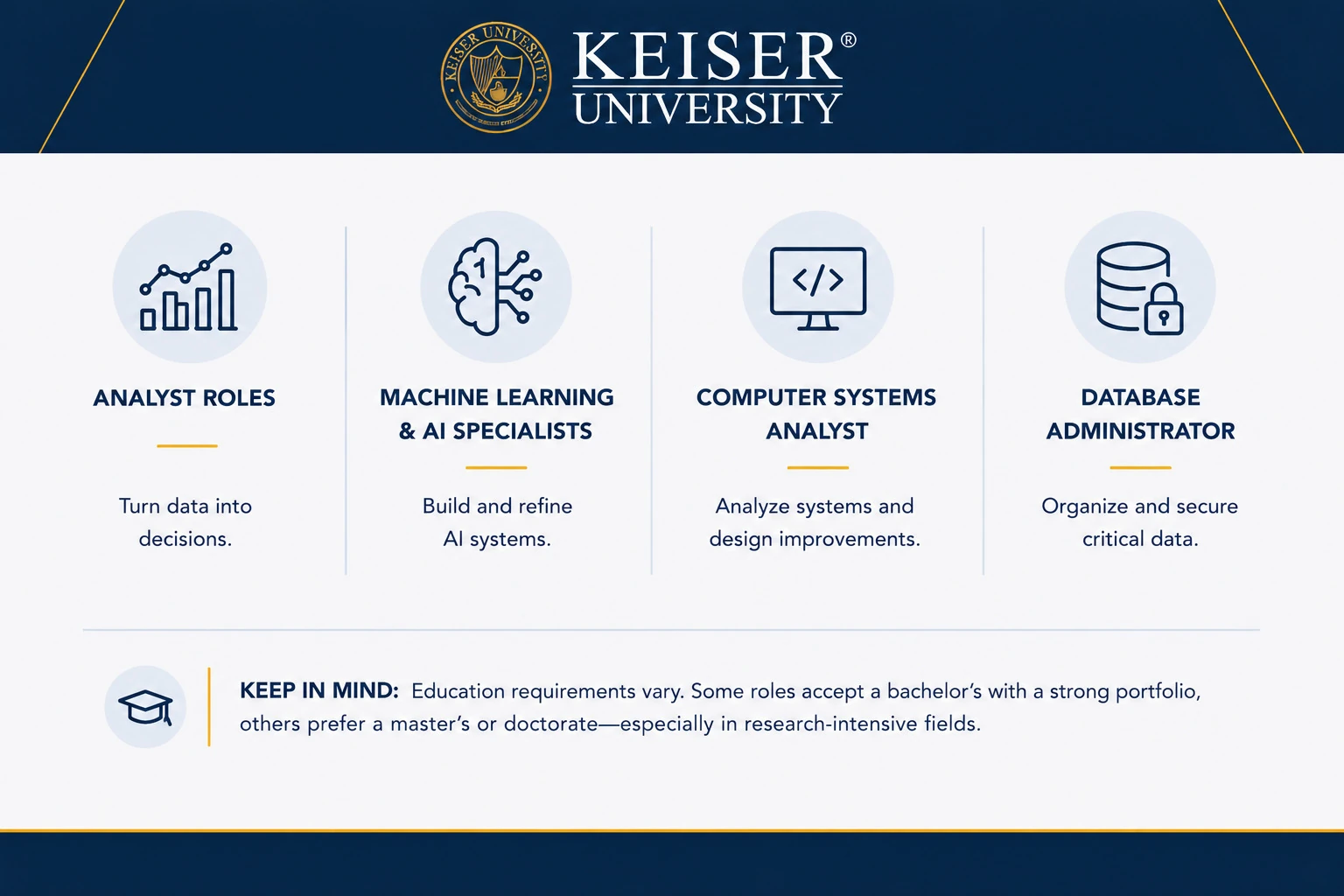
Roles in the data field include:
- Data analyst roles: Turn raw information into insights that organizations can use to make decisions.
- Machine learning and AI specialist roles: Build, test, and improve automated systems and models.
- Computer systems analyst: Studies an organization’s technology and designs more effective systems.
- Database administrator: Organizes, maintains, and secures the information an organization relies on.
Keep in mind: A job title does not always reveal the education required. Some data science positions accept a bachelor’s degree and a strong project portfolio, while research-heavy roles may require a master’s or doctoral degree.
Keiser University offers a bachelor’s in artificial intelligence, an associate degree in artificial intelligence, and a complete information technology program hub for students interested in this growing field.
Business and Management: Skills That Move Across Industries

Management occupations are projected to grow faster than the average for all occupations through 2034.
These roles had a median annual wage of over $125,000 in 2025, well above the median across all occupations.
Training and development specialists, who help employees build new skills, are projected to grow 11 percent over the same period, as organizations continue to invest in workforce development.
Communication and leadership remain especially valuable across business careers. The World Economic Forum’s Future of Jobs Report 2025 found that 63 percent of employers cite skill gaps as the top barrier to business transformation. Employers are also placing greater value on creative thinking, resilience, flexibility, and agility.
Roles within the business and management field include:
- Management analyst: Helps organizations improve efficiency and solve operational problems.
- Human resources specialist: Recruits, screens, and supports employees throughout their careers.
- Training and development specialist: Designs and leads programs that help employees build new skills.
- Marketing and accounting roles: Support the financial, operational, and growth needs found in every industry.
Use this checklist when choosing a business concentration:
- Decide whether you want to specialize in an area such as marketing or accounting, or stay broad with a general business degree or MBA.
- Consider whether you want to enter the workforce soon or build toward a long-term management track.
- Look for a program that gives you the flexibility to move between industries as your career develops.
Keiser University’s business program hub includes concentrations ranging from marketing to accounting. Additional resources on MSOL jobs, career growth, and top jobs and industries for MBA marketing graduates can help you compare possible paths.
Education: Steady Roles Behind the Scenes of Learning
Education careers can offer steady opportunities, particularly at the postsecondary level.
BLS projects postsecondary teacher employment to grow 7 percent from 2024 to 2035, faster than the average for all occupations. Training and development specialists, who often work in corporate or higher education settings, are expected to grow even faster.
Technology is also changing how instructors design courses, deliver lessons, and connect with students. This creates opportunities for professionals who understand both teaching and modern learning tools.
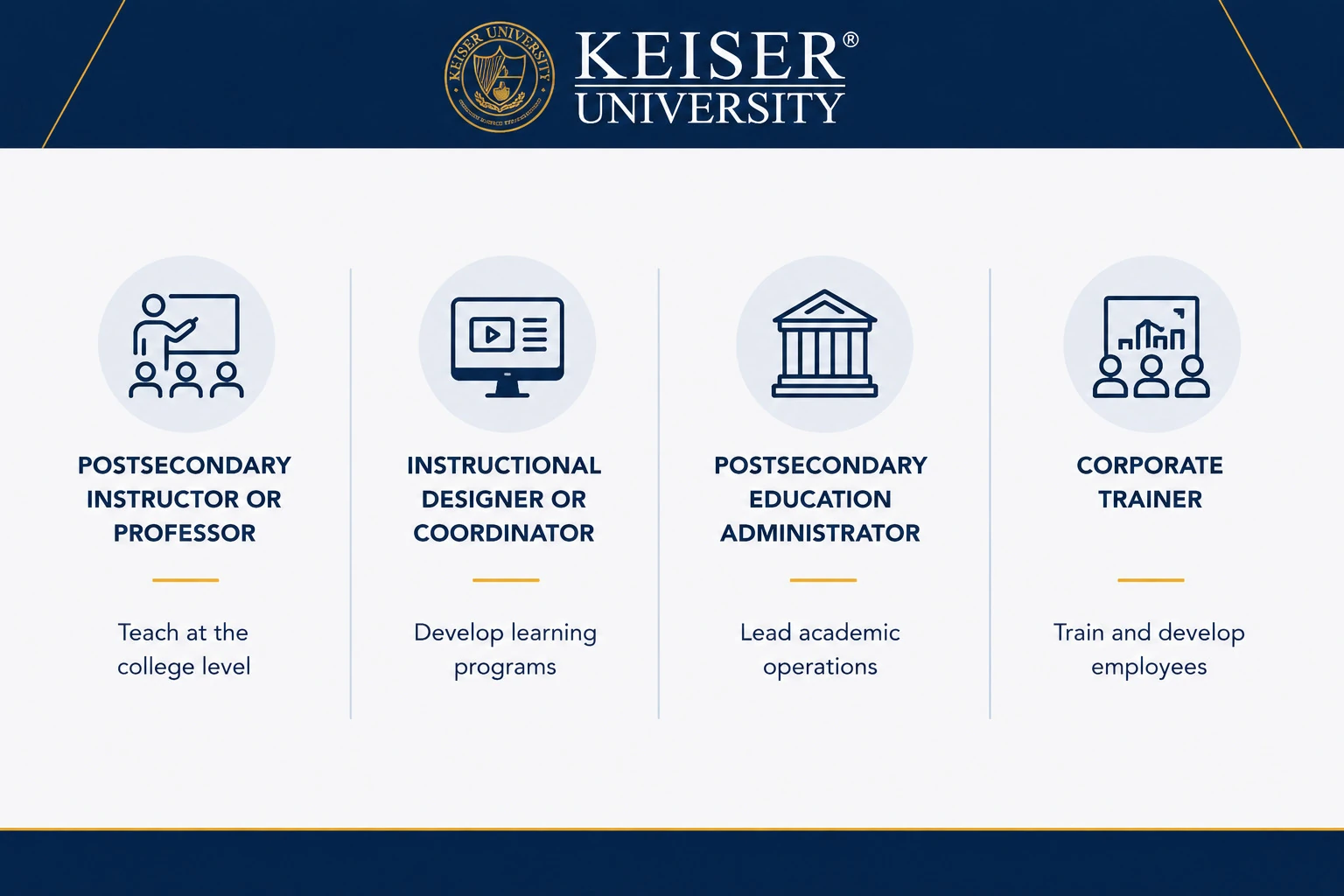
Roles in the education field include:
- Postsecondary instructor or professor: Teaches and mentors students at the college level.
- Instructional designer or coordinator: Develops curriculum, courses, and training materials.
- Postsecondary education administrator: Oversees academic programs, student services, or faculty operations.
- Corporate trainer: Leads employee learning and professional development outside a traditional classroom.
Read more about how modern academia is evolving, then explore Keiser’s education programs hub options for students interested in instructional or leadership roles.
Psychology and Counseling: A Growing Need for People Centered Careers
The need for counseling and behavioral health support continues to grow as more people seek help for addiction, anxiety, and other mental health concerns.
BLS projects employment for substance abuse, behavioral disorder, and mental health counselors to grow 18 percent from 2024 to 2035, much faster than the average for all occupations.
A psychology or counseling degree can also build transferable skills in research, communication, critical thinking, and understanding human behavior. These skills can be valuable in both clinical and nonclinical settings, including:
- Behavioral health technician: Supports patients and licensed counselors in treatment settings.
- Case manager: Connects clients with resources, treatment plans, and support networks.
- Human resources or community outreach professional: Applies an understanding of behavior in a nonclinical workplace or community setting.
- Licensed counselor: Provides professional counseling after completing a graduate degree, supervised clinical hours, and state licensure requirements.
Good to know: A bachelor’s degree can prepare you for support, outreach, and case management roles. Licensed counseling and other clinical careers generally require a master’s degree, supervised experience, and state licensure.
Keiser University’s counseling program hub includes a pathway to a master’s in clinical mental health counseling for students working toward licensure.
Criminal Justice and Public Safety: Careers That Hold Steady
Criminal Justice Program at Keiser University

Communities continue to need police protection, courts, corrections, and emergency services during periods of economic change.
BLS notes that the need for police services continues even when crime rates fall, while police and detective employment is projected to grow 3 percent from 2024 to 2035, in line with the average for all occupations.
Forensic science offers a faster-growing path within the same field. Employment for forensic science technicians is projected to grow 13 percent over the same period, more than four times the average rate. Part of this growth is linked to the increasing use of objective, technology-supported evidence in criminal cases.
Career options in the criminal justice and public safety field includes:
- Forensic science technician: Collects and analyzes physical evidence from crime scenes.
- Detective or criminal investigator: Gathers facts and evidence to support criminal investigations and prosecutions.
- Public safety and emergency management roles: Coordinate disaster response, preparedness, and community safety.
- Corrections and probation roles: Support supervision, rehabilitation, and reintegration within the justice system.
Explore Keiser University’s criminal justice programs to find your best fit. You can also read about high-growth criminal justice jobs and career opportunities with a doctorate in criminal justice.
Why Keiser University
For almost 50 years, Keiser University has prepared students for careers in demand with quality and career-focused education. With multiple Florida campuses and international locations, Keiser offers more than 100 programs at the associate, bachelor’s, master’s, and doctoral levels, including many of the fields covered in this guide.

Individual attention from a faculty of industry experts
Small class sizes and personalized mentorship create a more individualized learning experience, allowing faculty to understand your academic and career goals, provide guidance tailored to your needs, and offer meaningful support as you build the knowledge and skills needed for success.
Flexible Options and Support
Flexible scheduling, including online, on-campus, and hybrid formats, that fit the needs of working adults, military-affiliated students, international students, and traditional students alike. Dedicated student services stay with you from enrollment through graduation, and strong employer relationships help connect coursework to real careers.
Explore Programs in the Fields Featured in this Guide
Health Care | Nursing | Cybersecurity | Information Technology | Business | Education | Counseling | Criminal Justice | Public Safety
Ready to build a career in one of these fields?
Request information from Keiser University today and talk with an admissions counselor about the program that fits your goals. Request Information | Apply Now
Frequently Asked Questions
What are the highest-paying careers on this list?
Among the roles covered in this guide, information security analysts earned a median annual wage of over $124,000, while management occupations overall reported a median wage of over $125,000. Nurse practitioners and data scientists also rank among the higher-paying careers in their fields. Keep in mind that earnings can vary by location, experience, and specialization. It’s also recommended to check current wage data for the exact job title you are considering.
Do I need a four-year degree for a high-paying job?
Not always. Some health care support careers, forensic technician positions, and entry-level technology roles may accept an associate degree or relevant certification. Higher-paying or more advanced roles, including business management, nurse practitioner, cybersecurity analyst, and licensed counselor, generally require a bachelor’s degree or higher. Contact a Keiser admissions counselor to help you compare the education requirements for your target career.
Can any of these careers really survive a downturn?
No career comes with a guarantee, but fields tied to essential care, education, and public safety often maintain steadier demand during economic downturns. BLS notes that the need for police protection continues even when crime rates fall, and the need for health care rarely disappears during a recession. A broad skill set can give you more options as the economy changes.
What is the fastest growing career on this list?
Among the careers in this guide, advanced practice nursing shows the fastest projected growth. BLS projects 36 percent employment growth from 2024 to 2035 for nurse anesthetists, nurse midwives, and nurse practitioners combined. Data scientists follow closely, with 35 percent projected growth over the same period. Both fields also offer median pay above the national median.
How do I know if a career will hold up over time?
No career is completely future-proof, but roles that combine technical ability with judgment, communication, problem-solving, and person-to-person interaction may be less vulnerable to automation than routine tasks. Health care, counseling, public safety, and skilled technology roles often require this combination. Ongoing upskilling helps professionals stay current, competitive, and valuable in an evolving job market.
Can AI take away these jobs?
AI is changing how many of these jobs are performed, but it is less likely to replace careers built around direct patient care, in-person instruction, complex judgment, or hands-on investigation. Employers increasingly want candidates who can work confidently with new tools. In cybersecurity, data, and health care, automation is more often being added to existing roles than replacing the professionals who perform them.
What if I am not sure which field is right for me?
Uncertainty is a normal place to begin. One of our admissions counselors can help you compare programs before you commit to one path. General studies, introductory courses, internships, faculty mentorship, and career advising can also help you explore a field and make a more informed decision.
Does Keiser University offer online programs in these fields?
Yes. Keiser University offers many programs in online, traditional, and nontraditional formats. Flexible scheduling can help working adults, military-affiliated students, and traditional students continue their education while managing other responsibilities. Visit the programs page or request information to explore available fields and formats.
About Keiser University
Since 1977, Keiser University has been empowering students to achieve their career goals through career-focused, quality education. As one of Florida’s largest private, nonprofit universities, Keiser University is institutionally accredited by SACSCOC, demonstrating its commitment to rigorous educational quality standards. Founded by Dr. Arthur Keiser and Evelyn Keiser, the university is built on a student-centered model designed to support working adults, transfer students, and first-time college learners.
As a Keiser University student, you’ll benefit from:
- Over 100 associate, bachelor’s, master’s, and doctoral degree programs aligned with today’s workforce.
- Flexible learning options, including on-campus, online, hybrid, and one-class-at-a-time formats.
- Personalized academic and career support, with dedicated faculty and career services.
- Financial aid, scholarships, and tuition guidance to help make education more accessible.
- Almost 50 years of educational excellence with a proven focus on student success and outcomes.
Don’t wait to start building your future. Contact Keiser University today to learn how our programs, financial aid options, and career-focused approach can help you move forward with confidence.
Call toll-free 888-KEISER-9, contact a Keiser campus near you to take the first step toward your dream career.
Sources:
- https://www.bls.gov/ooh/computer-and-information-technology/information-security-analysts.htm
- https://www.bls.gov/news.release/pdf/ecopro.pdf
- https://www.bls.gov/emp/tables/fastest-growing-occupations.htm
- https://www.bls.gov/ooh/math/data-scientists.htm
- https://www.bls.gov/ooh/healthcare/nurse-anesthetists-nurse-midwives-and-nurse-practitioners.htm
- https://www.bls.gov/ooh/community-and-social-service/substance-abuse-behavioral-disorder-and-mental-health-counselors.htm
- https://www.bls.gov/ooh/business-and-financial/training-and-development-specialists.htm


 After experiencing profound personal loss, Sydney Nau found her purpose in nursing. Today, she leads with compassion while advancing her education and transforming lives through patient-centered care.


